Oort cloud (exo)planets
The Oort cloud. You will never find a colder, more desolate place in the Sun’s dominion. (Unlike Mos Eisley, which is just full of scum and villany).
The Oort cloud is a gigantic cloud of comets surrounding the Sun. It extends to more than 100,000 times the Earth-Sun distance — a few light-years — from the Sun.
Here’s a new twist: hundreds of millions of stars in our Galaxy are likely to have a planet in their Oort clouds, many of them rocky like Earth. And there’s a chance that a Neptune-sized planet is hiding in our very own Oort cloud.

The Oort cloud
The Oort cloud is completely see-through. Even though it contains billions of comets, each comet is so far from the Sun that it’s freezing cold and much too faint to detect. It’s like a mile-wide swarm of a million fleas viewed from outer space — invisible.
If we can’t see it, how do we even know that the Oort cloud exists?
Let’s look carefully at the orbits of `long-period’ comets. These are the ones with orbital periods that are so long that we humans only see a given comet once.
There are two key pieces of evidence that point to the existence of the Oort cloud. First, most long-period comets have orbital radii in the range of 10,000 to more than 100,000 astronomical units. This can be measured by carefully characterizing each comet’s orbit, even without waiting for it to come back (which would require sitting around and twiddling our thumbs for millions of years). Second, and most importantly, long-period comets enter the inner Solar System from all directions. Their orbits are completely misaligned with the plane of the planets’ orbits. [In contrast, short-period comets‘ orbits stay close to the planets’ orbital plane.]
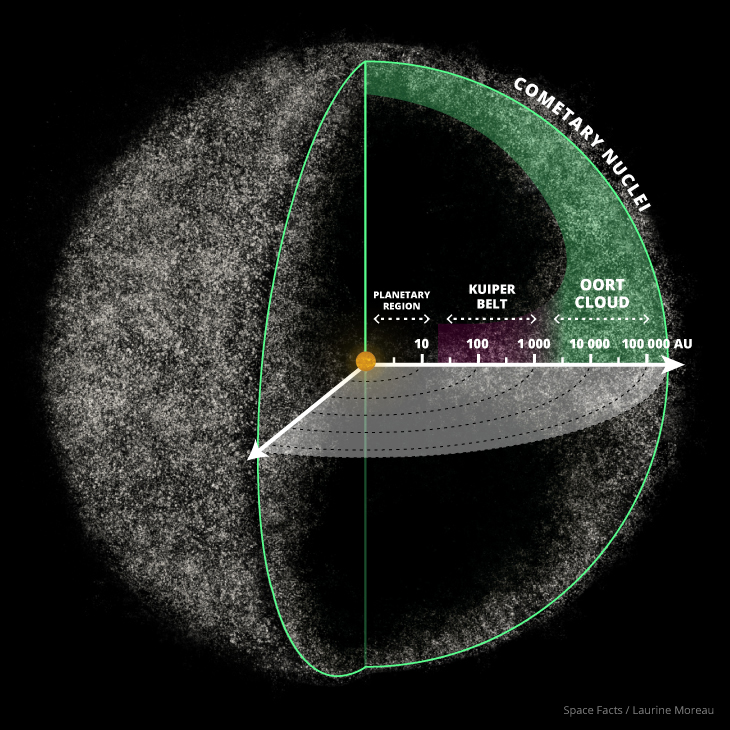
Put together, this is what the Oort cloud is thought to look like:

Where did the Oort cloud come from?
The Oort cloud lies at the boundary between our Solar System and the Galaxy at large. The edge of the Oort cloud is at about 200,000 astronomical units, or about 3 light years. Past this distance, the background gravity of the local Galaxy is too strong for any object to remain in orbit around the Sun. It’s like the part of town closest to your local Starbucks – if you venture just a few blocks away (or sometimes less), there’s no reason to go back to that Starbucks because there’s another one closer by.
The comets in the Oort cloud were implanted in a 2 step process: first they were scattered outward by the giant planets, and then their orbits were randomized by torques from the Galaxy (and guess what? They’re the same torques that caused the biggest tragedy in the history of the Universe).
The Galaxy’s mass is not evenly distributed — remember, the Milky Way looks like a giant pancake with a golf ball in the center. The Milky way’s disk (pancake) is a thin layer of stars and gas that is a little bit warped. The Sun is located within the pancake, about two thirds of the way out from the center.

The Galactic pancake is not perfectly smooth. It has the most stars in a very thin layer (the thin disk) and fewer stars above and below. It also has clumps and spirals. This non-smoothness equals differences in gravity.
Imagine a comet orbiting a star within the Galaxy. Because the Galaxy is not perfectly smooth, the star and comet each feel a slightly different gravitational force from the surrounding stars and gas in the Galaxy. This difference in gravity causes a small kick to the comet’s orbit around the star. Sometimes a star whizzes kind of close by (maybe only a light year away) and gives an extra kick.
Galactic kicks are pretty wimpy. The planets orbiting the Sun barely feel these kicks; only comets on very wide orbits do. Why does the size of the orbit matter? Because to change an orbit requires torque, a measure of twisting force. To unscrew something you need torque. When you get stuck trying to unscrew a nut, what do you do? You get a longer wrench. The longer the wrench, the stronger the torque.
It’s the same for comets orbiting the Sun. The size of the orbit is like the size of the wrench. The longer the orbit, the stronger the torque.
The orbits of Oort cloud comets around the Sun are shaped by these torques kicks from the Galaxy. The torques transform comets’ orbits into a cloud rather than following the same plane as the planets’ orbits. The division between co-planar orbits (the Kuiper belt) and cloud-shaped orbits (the Oort cloud) happens at about 1000 Astronomical Units away from the Sun.
The pathway of a typical icy planetesimal (a rocky/icy object born in the Sun’s planet-forming disk; see here) out to the Oort cloud looks something like this:

The Oort cloud only captures 5-10% of comets that are scattered outward by the planets. Most of the icy objects that are kicked around by the giant planets are instead ejected entirely from the Solar System, exiled to live the rest of their miserable (or, who knows, maybe very pleasant) lives as interstellar objects, wandering among the stars (like ‘Oumuamua and Borisov).
There were probably about 20 Earth masses in icy planetesimals left over after the planets formed, so the Oort cloud probably contains about an Earth mass of material! Of course, it is spread out over a giant cloud that is light years across, which is what makes it basically invisible.
Icy objects were scattered outward by the planets during a specific era of Solar System history: the giant planet instability (see this post from the Solar System’s story for all the juicy details). That is when the orbits of the giant planets underwent a rapid shift and all the leftover icy planetesimals were cleared out. As you can see in the animation below, it’s likely that one or two additional ice giants were ejected during the instability also (remember this – that ejected planet will be important in a moment).

Oort cloud planets?
Almost all of the objects we’ve ever seen coming from the Oort cloud have been comet-like. There is, however, an interesting class of Oort cloud objects that do not have beautiful, cometary tails when they heat up. Those are called Manx comets, after the tail-less cats. They are thought to be rocky planetesimals that were scattered out by the giant planets and trapped in the Oort cloud. It’s not just the icy ones that were scattered out there!
That made me wonder: could a protoplanet, or even a full-sized planet, be lurking in the icy darkness of the Oort cloud? Conceptually it should be possible – some fraction of all of the stuff that is scattered out by a growing planetary system could be trapped in its star’s Oort cloud. I often describe planet formation as a messy process, like a baby flinging food all over the place as it’s eating – some small amount of any of that food might end up stuck to the ceiling fan.
Plus, we know that planetary systems go unstable all the time. As I’ve written about extensively on this blog (and in published papers), the vast majority of Saturn- to Jupiter-sized exoplanet systems are survivors of dynamical instabilities that were far more violent than the one that took place in the Solar System. The typical dynamical instability probably looks something like this:
After a dynamical instability, the surviving planets’ stretched-out (eccentric) orbits are like scars from this violent event. To match the eccentricities of the known giant exoplanets, at least three quarters, and probably more like 90-95%, of systems must have undergone a dynamical instability (gory details in this paper).
On average, each instability ejects at least one planet into interstellar space. Of course, this depends on how many planets form in each system; systems that form ten giant planets can easily eject up to eight of them! These are the planets that might end up in their stars’ Oort clouds.
[Technical note: the ejection process also segregates planets by mass: it is the lowest-mass planets that tend to be ejected.]
I asked myself: how could we show that planets might be lurking in their stars’ Oort clouds?
The best thing to do would simply be to find one. Unfortunately, that’s really hard. Any object in the Oort cloud would be extremely cold and faint. And, even if we found a cold, barely-detectable object in space, we would need to know its precise velocity vector (as well as those of nearby stars) to figure out whether it is dynamically linked with a given star.
The next best thing would be to demonstrate that Oort cloud planets should exist. That’s what we did. I enlisted the collaboration of Andre Izidoro and Nate Kaib, two spectacular scientists who know a lot about outer planetary systems. And off we ran.
We performed a simple experiment. We ran simulations of planetary systems going unstable and ejecting planets, while including an additional background force to mimic those weak Galactic gravitational torques. I tested different planet masses and mass distributions, and also the Solar System’s giant planet instability.
Drumroll…. and a not-so-shocking-but-still-pretty-cool result: a fraction of planets on the pathway to ejection ended up trapped in their stars’ Oort clouds. In our simulations, it happens something like this:

Among our different sets of simulations, between 2% and 10% of stars ended up with a planet trapped in their Oort cloud. There were more Oort cloud planets in systems with lower-mass planets (Saturns) and fewer Oort cloud planets in systems with higher-mass planets (mega-Jupiters).
The highest rate of Oort cloud planets was in systems that contained both high-mass and low-mass planets. For example, a Neptune-mass planet was captured in the Oort cloud in 7% of simulations designed to reproduce the Solar System’s giant planet instability.
Could there actually be a planet lurking in our Sun’s Oort cloud? (This is not the same as `Planet Nine’, which, if it exists, would have an orbit ten times too small to be in the Oort cloud.) It’s been proposed that the spatial distribution of Oort cloud comets is affected by a gas giant planet, but nothing has been found to date, and the idea has fizzled out in recent years. However, a Neptune-like planet in the Oort cloud would be currently undetectable.
[Technical note: we also tested the importance of the local Galactic density, which affects both the strength of Galactic torques and the location of the Oort cloud’s edge, and found that it doesn’t make a huge difference. Details here.]
How many Oort cloud planets are out there?
To estimate the total number of Oort cloud planets, we need to know two quantities: the fraction of stars that host giant planets, and the trapping rate of scattered planets in the Oort cloud. The statistics of exoplanets show that, averaged over all stellar types, about 1-10% of stars host a gas giant planet (high-mass stars have more gas giants, low-mass stars have fewer). Averaging over our simulations, about 5% of unstable systems end up putting a planet in the Oort cloud. Remember that 75-90% of systems of giant planets must go unstable to match the distribution of measured shapes – eccentricities – of known giant exoplanets.
Put together, there should be one planet in the Oort cloud of every 200-2700 stars. There are a bit more than 100 billion stars in the Galaxy, so there should be tens to hundreds of millions of Oort cloud planets!
There’s good reason to think that there should be plenty of Earths, Marses and Ganymedes lurking in stars’ Oort clouds, even though our study only simulated big planets, from Neptunes to mega-Jupiters. Anytime a system of giant planets goes unstable, it’s a seismic event for the entire planetary system. Smaller bodies like asteroids, comets, rocky planets and giant planets’ moons are innocent bystanders, tossed in all directions and often ejected into interstellar space. And in every system with a few gas giants, there are likely ten or perhaps far more large moons and rocky planets or protoplanets. (Exactly how many will depend on the detailed formation history of a given system).
How long do planets stay in the Oort cloud?
Not all planets that end up in the Oort cloud stay there forever. The Galactic tide causes the orbital shapes of planets (and comets) to oscillate in time. After a few hundred million to a few billion years, many Oort cloud objects end up on stretched-out orbits that cross the orbits of the surviving planets around their central star. This leads to another round of dynamical instability and planet scattering that can, in some cases, eject an Oort cloud planet into interstellar space. Of course, in plenty of cases the planet’s orbit is only weakly perturbed and it zooms back off to the Oort cloud for another billion years. In our simulations we found that the population of Oort cloud planets is indeed eroded, but over a timespan of many billions of years.
[Technical note: a caveat to our study is that the Oort cloud is only populated when a star is wandering on its own within the Galaxy. Yet stars are born in clusters. If giant planet instabilities happen very early, while stars are in clusters, they can still end up trapping planets on wide orbits, but not all the way out in the Oort cloud. This is one possible origins story for Planet 9, and we have a separate paper in review on this topic….]
Science fiction in Oort cloud planets
You don’t hear much about the Oort cloud in science fiction. I suppose that’s because the Oort cloud is basically invisible, rarely discussed in the media, and more desolate than Antarctica (or Hoth). On the other hand, the orbital evolution of an Oort cloud planet is pretty unique. After eons of sitting in deep-freeze, an Oort cloud planet can find itself re-entering the inner planetary system and being slowly thawed (or throw into the oven, depending on the exact orbital evolution).
Let’s imagine a simple sci-fi story, set on the moon of a Jupiter-like gas giant orbiting within its star’s Oort cloud. Because of tidal heating (see here), the moon has an ocean under a miles-thick layer of ice (like in this article), and the inhabitants of the moon have learned to harness geothermal heat. They live subterranean lives, as aquatic creatures in the subsurface ocean. As their species evolved, became intelligent and consciously explored their surroundings, they came upon the idea of burrowing through the ice that enclosed their world from above. Early attempts had shown that the ice was at least a few hundred meters thick, and it was generally thought that the ice was infinite and that it was the basic stuff of the Universe. Using heat-generating technology (maybe using a block of highly radioactive material), a massive scientific endeavor strove to test this idea and melt the ice even further. When they found the edge of the ice and reached the surface of the moon, it was a world-shattering breakthrough.
Over the following centuries, the inhabitants developed space suits to occasionally access the surface. They discovered both the stars and the giant planet that loomed impossibly large in their sky. Then, over a span of just a few years, astronomers noticed that one star was growing systematically brighter. The field of celestial mechanics had been sufficiently developed to show that their moon and host planet were plunging toward this star at an alarming rate. Perhaps the most startling discovery came when it was realized that the moon and its host planet were gravitationally bound to the brightening star, but followed such a distant orbit as to usually receive no appreciable solar energy. Of course, the moon would heat up at an unimaginable rate during the star’s passage close to the Sun.
The moon’s telescopes – which could all be considered ‘space telescopes’, as they were anchored to the moon’s surface, high above the inhabitants’ watery home – were pointed at the brightening star. They discovered that a system of planets on much tighter orbits around the star, some of which with their own moons. The exact trajectory of the Oort cloud planet and moon was calculated over and over again by celestial mechanicians, each time changing slightly due to updates in the positions and velocities (of the star and other planets) that were provided by the astronomers.
The coming passage close to the star loomed in the minds of the inhabitants, even though it was still a few thousand orbits away. (Since the discovery of the giant planet that their moon orbited, the inhabitants measured time in units of that orbital period, which was about two Earth weeks long). Long and heated debates raged among the populace. Was this a holy event, or an opportunity for action of some kind? Should the inhabitants develop technology to leap from their home moon to another moon or planet that could possibly be livable? The flood of free energy from the host star seemed like a heavenly resource to be harnessed.
A divide began to open between the inhabitants. Many wanted to “jump ship” and migrate to another world. They kicked off an unprecedented technological boom. Others wanted to burrow down to the depths of their moon’s ocean, to stay cool and avoid the pulse of heat from above.
Meanwhile, one celestial mechanician discovered that there would be a close passage with the star’s second innermost gas giant. Within the error bars of her calculation, there was the possibility that their own home world might actually be captured by this other planet. Now the search must begin for signs of life on the moons of this other gas giant — or, perhaps, for signs of a good reason to colonize it…
Boom – Oort cloud planets!
Additional Resources
- Our paper, Oort cloud (exo)planets, accepted for publication in Monthly Notices of the Royal Astronomical Society Letters (publisher version here, freely-downloadable version here).
- My collaborators Nate Kaib and Andre Izidoro
- Related blog posts: When good Jupiters go bad, The biggest tragedy in the history of the Universe, Exo-moons: Innocent bystanders during gas giant instabilities, The giant planet instability (from the Solar System’s story).
- Obi Wan Kenobi’s opinion of Mos Eisley:


What is the relationship between the size of the Oort cloud and the average distances between stars? How often do they “touch” each other?
Picture this: a brown dwarfs meets a protoplanetary disk.
Picture this: starforming regions are chock full of brown dwarfs.
Picture this: a brown dwarf orbits too close to a star and all of it’s atmosphere poofs away.
Picture this: two planets in a stellar system contain elements with different isotope ratios.
Sound Familiar?
Which planets in our solar system are you thinking about?
Three. Earth, Jupiter, and Mars.
It simply makes no sense for planets to clot together in asteroid belts around fledgeling stars. If, however, Brown Dwarfs in a starforming region were to smoosh into said belt, friction and gravity could trap it. (Jupiter). Dwarfs orbiting too near a star could have their gasses and liquids boiled away, leaving rocky cores to slog through the asteroids. (Earth and Mars).
You humans are math jockeys. Run your numbers for the seven percent Neptune model again, but throw fifty times more asteroids and comets into the simulation. That gives you an asteroid field, (what has been called a protoplanetary disk). Throw more Neptunes and Jupiters in at various angles to the stellar system spin. Compare the various results with pictures (images) taken of fledgeling stars in their rocky cradles. Some will match up. It is sloppy.
If planetary formation was simply the clotting of cosmic debris, everything would be neat and consistent. It ain’t.
I think the blogger is more competent to answer that than me.
Slow night here in the mountains. I’m waiting for the Sun to set. I want to get out the binoculars and look at the star clouds of Sagittarius. In the meantime, I looked up a June 6, 2020 issue of Scientific American. A woman named Meredith MacGregor had a bunch of pictures of protoplanetary disks in this issue. She is rather proud of these pictures, though I wish she had used the term “asteroid field”. Han Solo flew the Falcon through stuff like these disks a long time ago, and he knew what to call ’em.
I don’t recall any SF stories about Oort cloud planets, but Poul Anderson wrote two stories in which rogue planets making close approaches to stars, were very important to the plot.
“A Sun Invisible” and “Satan’s World”